Explorer
Log in

Visite historique à pied et conte de Charleston

Aperçu
This tour is an exploration of Charleston that highlights the women and men who helped found Charleston and the United States.

Did you know, without the pirates and patriots of Charleston, the United States may not exist today?

We start our experience in front of the Old Exchange and Provost Dungeon, one of Charleston’s oldest and most historical buildings. Learn about George Washington’s visit in 1791, and the dungeon’s prisoners who met their fate.

Next, we venture down East Bay Street, passing Rainbow Row. Behold gorgeous mansions, and witness breathtaking views of the Charleston Harbor and White Point Garden. Walk in the footsteps of pirates and their captors.

Next, we turn inward and walk through Charleston’s South of Broad neighborhood. Learn about the man George Washington and Thomas Jefferson said was the true father of America.

Last, we venture back to our starting point, passing by the Four Corners of the Law and the shops and residences on Broad Street.

Ville: Charleston
Tue 06 Jan
i
Vous pouvez déjà choisir la date sur le site de réservation
À partir de $35.90
Tue 06 Jan
À partir de $35.90
Faire une réservation
Ce qui est inclu
Museum entry fee for the Philip Simmons House at 30-1/2 Blake Street.
Entry fee for the Halsey Gallery of Contemporary Art at 161 Calhoun Street.
Museum entry fee for the Philip Simmons House at 30-1/2 Blake Street.
Entry fee for the Halsey Gallery of Contemporary Art at 161 Calhoun Street.
Museum entry fee for the Philip Simmons House at 30-1/2 Blake Street.
Entry fee for the Halsey Gallery of Contemporary Art at 161 Calhoun Street.
Museum entry fee for the Philip Simmons House at 30-1/2 Blake Street.
Information additionnelle
  • Wheelchair accessible
  • Infants and small children can ride in a pram or stroller
  • Service animals allowed
  • Public transportation options are available nearby
  • Transportation options are wheelchair accessible
  • All areas and surfaces are wheelchair accessible
  • Suitable for all physical fitness levels
À quoi s'attendre
1
Old Exchange & Provost Dungeon
Built in 1771 as a commercial exchange and custom house, the Old Exchange and Provost Dungeon has been a Charleston landmark for nearly 250 years. Today, it is a non-profit historic site that focuses on the American Revolution and colonial Charleston.
2
Rainbow Row
Rainbow Row is the name for a series of thirteen colorful historic houses in Charleston, South Carolina. It represents the longest cluster of Georgian row houses in the United States. The houses are located north of Tradd St. and south of Elliott St. on East Bay Street, that is, 79 to 107 East Bay Street. The name Rainbow Row was coined after the pastel colors they were painted as they were restored in the 1930s and 1940s.
3
Edmondston-Alston House
The house is built on the foundation ruins of Fort Mechanic that was at this location in the later part of the eighteenth century. Shipping merchant Charles Edmondston, a Scottish immigrant from the Shetland Islands, had purchased the low sandy lot in 1817. The unstable soggy land was unfit for residential construction until a sea wall was built. Charleston city officials built one in 1820 and Edmondston then started the construction of the house. The antebellum modified Charleston single house (side-hall) was constructed between 1820 and 1828. Edmondston had built the house originally in the English Regency style architecture.
4
Battery & White Point Gardens
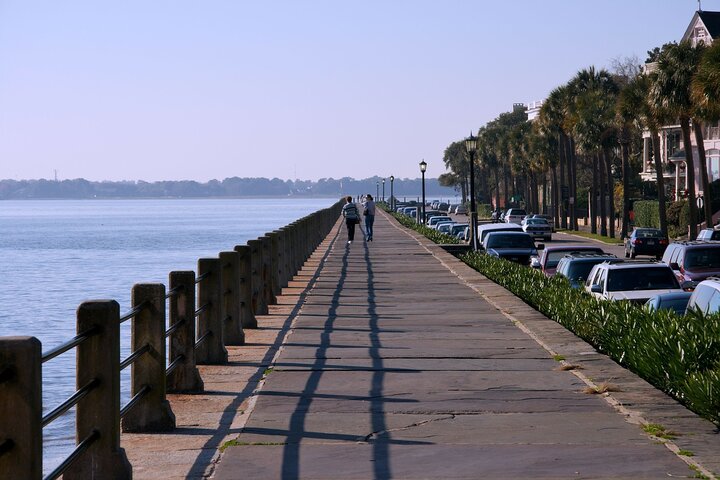
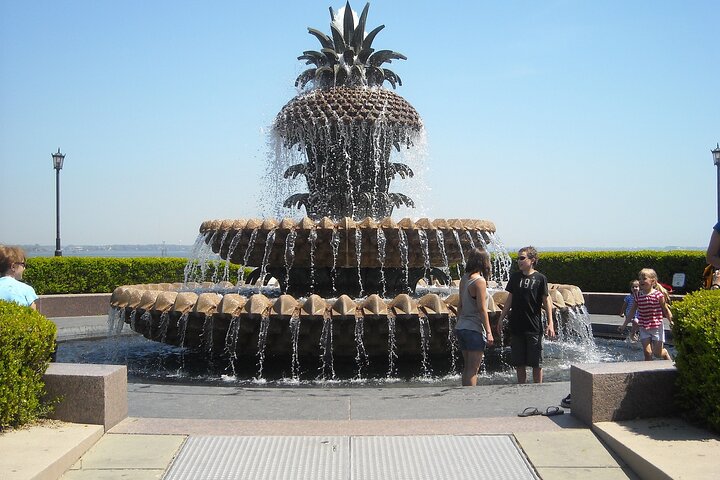
White Point Garden is a 5.7 acre public park located in peninsular Charleston, South Carolina, at the tip of the peninsula. It is the southern terminus for the Battery, a defensive seawall and promenade. It is bounded by East Battery (to the east), Murray Blvd. (to the south), King St. (to the west), and South Battery (to the north).
5
The Williams Mansion
The 24,000-square-foot house has thirty main rooms and many more smaller rooms. The main hall is 50 feet long and 14 feet wide. The house has a ballroom with a 45-foot-high ceiling.
6
Nathaniel Russell House
The Nathaniel Russell House is a historic house at 51 Meeting Street in Charleston, South Carolina, United States. Built by slave trader and wealthy merchant Nathaniel Russell in 1808, it is recognized as one of America's most important Neoclassical houses. It was designated a National Historic Landmark in 1973.
7
Old Exchange & Provost Dungeon
Built in 1771 as a commercial exchange and custom house, the Old Exchange and Provost Dungeon has been a Charleston landmark for nearly 250 years. Today, it is a non-profit historic site that focuses on the American Revolution and colonial Charleston.
8
Rainbow Row
Rainbow Row is the name for a series of thirteen colorful historic houses in Charleston, South Carolina. It represents the longest cluster of Georgian row houses in the United States. The houses are located north of Tradd St. and south of Elliott St. on East Bay Street, that is, 79 to 107 East Bay Street. The name Rainbow Row was coined after the pastel colors they were painted as they were restored in the 1930s and 1940s.
9
Edmondston-Alston House
The house is built on the foundation ruins of Fort Mechanic that was at this location in the later part of the eighteenth century. Shipping merchant Charles Edmondston, a Scottish immigrant from the Shetland Islands, had purchased the low sandy lot in 1817. The unstable soggy land was unfit for residential construction until a sea wall was built. Charleston city officials built one in 1820 and Edmondston then started the construction of the house. The antebellum modified Charleston single house (side-hall) was constructed between 1820 and 1828. Edmondston had built the house originally in the English Regency style architecture.
10
Battery & White Point Gardens
White Point Garden is a 5.7 acre public park located in peninsular Charleston, South Carolina, at the tip of the peninsula. It is the southern terminus for the Battery, a defensive seawall and promenade. It is bounded by East Battery (to the east), Murray Blvd. (to the south), King St. (to the west), and South Battery (to the north).
11
The Williams Mansion
The 24,000-square-foot house has thirty main rooms and many more smaller rooms. The main hall is 50 feet long and 14 feet wide. The house has a ballroom with a 45-foot-high ceiling.
12
Nathaniel Russell House
The Nathaniel Russell House is a historic house at 51 Meeting Street in Charleston, South Carolina, United States. Built by slave trader and wealthy merchant Nathaniel Russell in 1808, it is recognized as one of America's most important Neoclassical houses. It was designated a National Historic Landmark in 1973.
13
Ancienne bourse et donjon du prévôt
Construit en 1771 en tant qu'échange commercial et maison de douane, le Old Exchange and Provost Dungeon est un point de repère de Charleston depuis près de 250 ans. Aujourd'hui, c'est un site historique à but non lucratif qui se concentre sur la Révolution américaine et le Charleston colonial.
14
Arc-en-ciel
Rainbow Row est le nom d'une série de treize maisons historiques colorées à Charleston, en Caroline du Sud. Il représente le plus long groupe de maisons en rangée géorgiennes aux États-Unis. Les maisons sont situées au nord de la rue Tradd et au sud de la rue Elliott sur la rue East Bay, c'est-à-dire du 79 au 107, rue East Bay. Le nom Rainbow Row a été inventé après les couleurs pastel qu'ils ont été peintes lors de leur restauration dans les années 1930 et 1940.
15
Maison Edmondston-Alston
La maison est construite sur les ruines de la fondation de Fort Mechanic qui se trouvait à cet endroit à la fin du XVIIIe siècle. Le marchand maritime Charles Edmondston, un immigrant écossais des îles Shetland, avait acheté le terrain sablonneux bas en 1817. Le terrain détrempé et instable était impropre à la construction résidentielle jusqu'à ce qu'une digue soit construite. Les fonctionnaires de la ville de Charleston en ont construit un en 1820 et Edmondston a alors commencé la construction de la maison. La maison individuelle Charleston modifiée d'avant-guerre (hall latéral) a été construite entre 1820 et 1828. Edmondston avait construit la maison à l'origine dans l'architecture de style anglais Regency.
16
Jardins de la batterie et du point blanc
White Point Garden est un parc public de 5,7 acres situé dans la péninsule de Charleston, en Caroline du Sud, à la pointe de la péninsule. C'est le terminus sud de la Batterie, une digue défensive et une promenade. Il est délimité par East Battery (à l'est), Murray Blvd. (au sud), King St. (à l'ouest) et South Battery (au nord).
17
Le manoir Williams
La maison de 24 000 pieds carrés compte trente pièces principales et de nombreuses autres pièces plus petites. Le hall principal mesure 50 pieds de long et 14 pieds de large. La maison a une salle de bal avec un plafond de 45 pieds de haut.
18
Maison Nathaniel Russell
La Nathaniel Russell House est une maison historique située au 51 Meeting Street à Charleston, en Caroline du Sud, aux États-Unis. Construit par le marchand d'esclaves et riche marchand Nathaniel Russell en 1808, il est reconnu comme l'une des maisons néoclassiques les plus importantes d'Amérique. Il a été désigné monument historique national en 1973.
19
Old Exchange & Provost Dungeon
Built in 1771 as a commercial exchange and custom house, the Old Exchange and Provost Dungeon has been a Charleston landmark for nearly 250 years. Today, it is a non-profit historic site that focuses on the American Revolution and colonial Charleston.
20
Rainbow Row
Rainbow Row is the name for a series of thirteen colorful historic houses in Charleston, South Carolina. It represents the longest cluster of Georgian row houses in the United States. The houses are located north of Tradd St. and south of Elliott St. on East Bay Street, that is, 79 to 107 East Bay Street. The name Rainbow Row was coined after the pastel colors they were painted as they were restored in the 1930s and 1940s.
21
Edmondston-Alston House
The house is built on the foundation ruins of Fort Mechanic that was at this location in the later part of the eighteenth century. Shipping merchant Charles Edmondston, a Scottish immigrant from the Shetland Islands, had purchased the low sandy lot in 1817. The unstable soggy land was unfit for residential construction until a sea wall was built. Charleston city officials built one in 1820 and Edmondston then started the construction of the house. The antebellum modified Charleston single house (side-hall) was constructed between 1820 and 1828. Edmondston had built the house originally in the English Regency style architecture.
22
Battery & White Point Gardens
White Point Garden is a 5.7 acre public park located in peninsular Charleston, South Carolina, at the tip of the peninsula. It is the southern terminus for the Battery, a defensive seawall and promenade. It is bounded by East Battery (to the east), Murray Blvd. (to the south), King St. (to the west), and South Battery (to the north).
23
The Williams Mansion
The 24,000-square-foot house has thirty main rooms and many more smaller rooms. The main hall is 50 feet long and 14 feet wide. The house has a ballroom with a 45-foot-high ceiling.
24
Nathaniel Russell House
The Nathaniel Russell House is a historic house at 51 Meeting Street in Charleston, South Carolina, United States. Built by slave trader and wealthy merchant Nathaniel Russell in 1808, it is recognized as one of America's most important Neoclassical houses. It was designated a National Historic Landmark in 1973.
25
Old Exchange & Provost Dungeon
Built in 1771 as a commercial exchange and custom house, the Old Exchange and Provost Dungeon has been a Charleston landmark for nearly 250 years. Today, it is a non-profit historic site that focuses on the American Revolution and colonial Charleston.
26
Rainbow Row
Rainbow Row is the name for a series of thirteen colorful historic houses in Charleston, South Carolina. It represents the longest cluster of Georgian row houses in the United States. The houses are located north of Tradd St. and south of Elliott St. on East Bay Street, that is, 79 to 107 East Bay Street. The name Rainbow Row was coined after the pastel colors they were painted as they were restored in the 1930s and 1940s.
27
Edmondston-Alston House
The house is built on the foundation ruins of Fort Mechanic that was at this location in the later part of the eighteenth century. Shipping merchant Charles Edmondston, a Scottish immigrant from the Shetland Islands, had purchased the low sandy lot in 1817. The unstable soggy land was unfit for residential construction until a sea wall was built. Charleston city officials built one in 1820 and Edmondston then started the construction of the house. The antebellum modified Charleston single house (side-hall) was constructed between 1820 and 1828. Edmondston had built the house originally in the English Regency style architecture.
28
Battery & White Point Gardens
White Point Garden is a 5.7 acre public park located in peninsular Charleston, South Carolina, at the tip of the peninsula. It is the southern terminus for the Battery, a defensive seawall and promenade. It is bounded by East Battery (to the east), Murray Blvd. (to the south), King St. (to the west), and South Battery (to the north).
29
The Williams Mansion
The 24,000-square-foot house has thirty main rooms and many more smaller rooms. The main hall is 50 feet long and 14 feet wide. The house has a ballroom with a 45-foot-high ceiling.
30
Nathaniel Russell House
The Nathaniel Russell House is a historic house at 51 Meeting Street in Charleston, South Carolina, United States. Built by slave trader and wealthy merchant Nathaniel Russell in 1808, it is recognized as one of America's most important Neoclassical houses. It was designated a National Historic Landmark in 1973.
31
Old Exchange & Provost Dungeon
Built in 1771 as a commercial exchange and custom house, the Old Exchange and Provost Dungeon has been a Charleston landmark for nearly 250 years. Today, it is a non-profit historic site that focuses on the American Revolution and colonial Charleston.
32
Rainbow Row
Rainbow Row is the name for a series of thirteen colorful historic houses in Charleston, South Carolina. It represents the longest cluster of Georgian row houses in the United States. The houses are located north of Tradd St. and south of Elliott St. on East Bay Street, that is, 79 to 107 East Bay Street. The name Rainbow Row was coined after the pastel colors they were painted as they were restored in the 1930s and 1940s.
33
Edmondston-Alston House
The house is built on the foundation ruins of Fort Mechanic that was at this location in the later part of the eighteenth century. Shipping merchant Charles Edmondston, a Scottish immigrant from the Shetland Islands, had purchased the low sandy lot in 1817. The unstable soggy land was unfit for residential construction until a sea wall was built. Charleston city officials built one in 1820 and Edmondston then started the construction of the house. The antebellum modified Charleston single house (side-hall) was constructed between 1820 and 1828. Edmondston had built the house originally in the English Regency style architecture.
34
Battery & White Point Gardens
White Point Garden is a 5.7 acre public park located in peninsular Charleston, South Carolina, at the tip of the peninsula. It is the southern terminus for the Battery, a defensive seawall and promenade. It is bounded by East Battery (to the east), Murray Blvd. (to the south), King St. (to the west), and South Battery (to the north).
35
The Williams Mansion
The 24,000-square-foot house has thirty main rooms and many more smaller rooms. The main hall is 50 feet long and 14 feet wide. The house has a ballroom with a 45-foot-high ceiling.
36
Nathaniel Russell House
The Nathaniel Russell House is a historic house at 51 Meeting Street in Charleston, South Carolina, United States. Built by slave trader and wealthy merchant Nathaniel Russell in 1808, it is recognized as one of America's most important Neoclassical houses. It was designated a National Historic Landmark in 1973.
37
Old Exchange & Provost Dungeon
Built in 1771 as a commercial exchange and custom house, the Old Exchange and Provost Dungeon has been a Charleston landmark for nearly 250 years. Today, it is a non-profit historic site that focuses on the American Revolution and colonial Charleston.
38
Rainbow Row
Rainbow Row is the name for a series of thirteen colorful historic houses in Charleston, South Carolina. It represents the longest cluster of Georgian row houses in the United States. The houses are located north of Tradd St. and south of Elliott St. on East Bay Street, that is, 79 to 107 East Bay Street. The name Rainbow Row was coined after the pastel colors they were painted as they were restored in the 1930s and 1940s.
39
Edmondston-Alston House
The house is built on the foundation ruins of Fort Mechanic that was at this location in the later part of the eighteenth century. Shipping merchant Charles Edmondston, a Scottish immigrant from the Shetland Islands, had purchased the low sandy lot in 1817. The unstable soggy land was unfit for residential construction until a sea wall was built. Charleston city officials built one in 1820 and Edmondston then started the construction of the house. The antebellum modified Charleston single house (side-hall) was constructed between 1820 and 1828. Edmondston had built the house originally in the English Regency style architecture.
40
Battery & White Point Gardens
White Point Garden is a 5.7 acre public park located in peninsular Charleston, South Carolina, at the tip of the peninsula. It is the southern terminus for the Battery, a defensive seawall and promenade. It is bounded by East Battery (to the east), Murray Blvd. (to the south), King St. (to the west), and South Battery (to the north).
41
The Williams Mansion
The 24,000-square-foot house has thirty main rooms and many more smaller rooms. The main hall is 50 feet long and 14 feet wide. The house has a ballroom with a 45-foot-high ceiling.
42
Nathaniel Russell House
The Nathaniel Russell House is a historic house at 51 Meeting Street in Charleston, South Carolina, United States. Built by slave trader and wealthy merchant Nathaniel Russell in 1808, it is recognized as one of America's most important Neoclassical houses. It was designated a National Historic Landmark in 1973.
43
Old Exchange & Provost Dungeon
Built in 1771 as a commercial exchange and custom house, the Old Exchange and Provost Dungeon has been a Charleston landmark for nearly 250 years. Today, it is a non-profit historic site that focuses on the American Revolution and colonial Charleston.
44
Rainbow Row
Rainbow Row is the name for a series of thirteen colorful historic houses in Charleston, South Carolina. It represents the longest cluster of Georgian row houses in the United States. The houses are located north of Tradd St. and south of Elliott St. on East Bay Street, that is, 79 to 107 East Bay Street. The name Rainbow Row was coined after the pastel colors they were painted as they were restored in the 1930s and 1940s.
45
Edmondston-Alston House
The house is built on the foundation ruins of Fort Mechanic that was at this location in the later part of the eighteenth century. Shipping merchant Charles Edmondston, a Scottish immigrant from the Shetland Islands, had purchased the low sandy lot in 1817. The unstable soggy land was unfit for residential construction until a sea wall was built. Charleston city officials built one in 1820 and Edmondston then started the construction of the house. The antebellum modified Charleston single house (side-hall) was constructed between 1820 and 1828. Edmondston had built the house originally in the English Regency style architecture.
46
Battery & White Point Gardens
White Point Garden is a 5.7 acre public park located in peninsular Charleston, South Carolina, at the tip of the peninsula. It is the southern terminus for the Battery, a defensive seawall and promenade. It is bounded by East Battery (to the east), Murray Blvd. (to the south), King St. (to the west), and South Battery (to the north).
47
The Williams Mansion
The 24,000-square-foot house has thirty main rooms and many more smaller rooms. The main hall is 50 feet long and 14 feet wide. The house has a ballroom with a 45-foot-high ceiling.
48
Nathaniel Russell House
The Nathaniel Russell House is a historic house at 51 Meeting Street in Charleston, South Carolina, United States. Built by slave trader and wealthy merchant Nathaniel Russell in 1808, it is recognized as one of America's most important Neoclassical houses. It was designated a National Historic Landmark in 1973.
49
Old Exchange & Provost Dungeon
Built in 1771 as a commercial exchange and custom house, the Old Exchange and Provost Dungeon has been a Charleston landmark for nearly 250 years. Today, it is a non-profit historic site that focuses on the American Revolution and colonial Charleston.
50
Rainbow Row
Rainbow Row is the name for a series of thirteen colorful historic houses in Charleston, South Carolina. It represents the longest cluster of Georgian row houses in the United States. The houses are located north of Tradd St. and south of Elliott St. on East Bay Street, that is, 79 to 107 East Bay Street. The name Rainbow Row was coined after the pastel colors they were painted as they were restored in the 1930s and 1940s.
51
Edmondston-Alston House
The house is built on the foundation ruins of Fort Mechanic that was at this location in the later part of the eighteenth century. Shipping merchant Charles Edmondston, a Scottish immigrant from the Shetland Islands, had purchased the low sandy lot in 1817. The unstable soggy land was unfit for residential construction until a sea wall was built. Charleston city officials built one in 1820 and Edmondston then started the construction of the house. The antebellum modified Charleston single house (side-hall) was constructed between 1820 and 1828. Edmondston had built the house originally in the English Regency style architecture.
52
Battery & White Point Gardens
White Point Garden is a 5.7 acre public park located in peninsular Charleston, South Carolina, at the tip of the peninsula. It is the southern terminus for the Battery, a defensive seawall and promenade. It is bounded by East Battery (to the east), Murray Blvd. (to the south), King St. (to the west), and South Battery (to the north).
53
The Williams Mansion
The 24,000-square-foot house has thirty main rooms and many more smaller rooms. The main hall is 50 feet long and 14 feet wide. The house has a ballroom with a 45-foot-high ceiling.
54
Nathaniel Russell House
The Nathaniel Russell House is a historic house at 51 Meeting Street in Charleston, South Carolina, United States. Built by slave trader and wealthy merchant Nathaniel Russell in 1808, it is recognized as one of America's most important Neoclassical houses. It was designated a National Historic Landmark in 1973.
Show 51 plus d'arrêts
Politique d'annulation
For a full refund, cancel at least 24 hours before the scheduled departure time.
Photos de voyageurs
Commentaires (18)
John_K
Mar 2025
Larry was a great tour guide. Not sure all his history is perfectly accurate but he’s a terrific storyteller. We definitely enjoyed it.
A4707GKgracep
Mar 2025
Larry is the best tour guide ever! We had a wonderful two hour walking tour of downtown Charleston but it was not physically strenuous. Larry connected the dots of history to paint a realistic picture of Charleston. I went on this tour with two of my girl friends. Three girls in our young twenties found this tour amazing and incredibly interesting. We covered important/serious topics like slavery’s influence on Charleston but also lighthearted anecdotal stories about different buildings and neighbors we passed. I would attend this tour again! I learned so much and Larry left us with lots of ideas to ponder.
Evelyn_I
Jul 2024
This tour exceeded my expectations. We chose the 3pm tour. It turned out that my husband and I were the only ones on the tour that day. So we wound up having a wonderful personalized experience. Our tour guide had a wealth of knowledge. He was very amusing too. We liked the way the walk and information was planned out. Although there is shade along the way, if you choose this tour during the summer wear sunscreen, a hat, and carry a bottle of very cold water. I definitely recommend this tour.

Événements connexes

Événements dans le même quartier

Nous pensons que votre langue est English
Dans quelle langue souhaitez-vous voir cette page ?
English English
Nous pensons que votre ville est La ville de New York
Dans quelle ville souhaitez-vous explorer ?
La ville de New York
New York City